


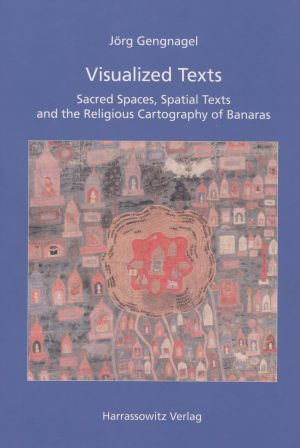
Blaues Cover des Buches "Visualized Texts. Sacred Spaces, Spatial Texts and the Religious Cartography of Banaras“ von Jörg Gengnagel, Band 7 der Reihe Ethno-Indology:  Heidelberg Studies in South Asian Rituals

How to Cite

Gengnagel, Jörg: Visualized Texts: Sacred Spaces, Spatial Texts and the Religious Cartography of Banaras, Heidelberg: Heidelberg Asian Studies Publishing, 2025 (Ethno-Indology: Heidelberg Studies in South Asian Rituals, Volume 7). https://doi.org/10.11588/hasp.1631

Identifiers

ISBN 978-3-98887-040-7 (PDF)

Published

09/15/2025
The print edition was published in 2011 by Harrassowitz Verlag, Wiesbaden. ISBN 978-3-447-05732-5

Authors

Jörg Gengnagel

Visualized Texts

Sacred Spaces, Spatial Texts and the Religious Cartography of Banaras

The study of the history of South Asian cartography has long been interpreted based on Western cartographic traditions. Maps of the South Asian subcontinent were assumed to be produced by foreigners – not by South Asians themselves. Maps actually produced in South Asia were neglected as a category in their own right. The present study focuses on the religious cartography of the north Indian pilgrimage center Banaras (Varanasi). It deals with visualizations of the sacred topography of Banaras as represented by various kinds of “maps”, including painted pictorial maps, printed pilgrimage maps and simple spatial charts. The introduction to the volume is followed by a study of the textual background of the studied cartographic material. It then presents a nineteenth century debate on the Pancakroshi procession as a case study on the interrelation of maps, texts and pilgrimage practice. The following section presents the first detailed study of four pilgrimage maps produced during the 18th and 19th century. The volume concludes with extensive indices that provide access to the numerous names of gods, places and temples contained in the studied maps, texts and processions.


Jörg Gengnagel is Professor and head of the Department of Indology at the Institute for Cultural Studies of East and South Asia at Julius-Maximilians-Universität Würzburg. At present he is director of the Merian- Tagore International Centre of Advanced Studies 'Metamoprhoses of the Political' (ICAS:MP) in Delhi. Until 2023 he was head of the DAAD funded Indo-German project on “Cultures of Learning in Varanasi” (A New Passage to India).

Among his fields of interest are medieval Shaivism, the religious topography of Varanasi, and the relation of spatial texts, cartography, and ritual performances in South Asia.

Chapters

Table of Contents
Pages
PDF
Frontmatter
1-4
Contents
5-6
Acknowledgements
7-8
Illustrations
9-11
Abbreviations
12
1. Introduction
13-21
2. Kāśīkhaṇḍokta–Kāśī in Texts
23-53
3. Kāśīyātrā–Maps and Processions in Banaras
55-72
4. Kāśīdarśana–Kāśī in Maps
73-185
5. Conclusion
187-193
Plates
195-215
Appendices
217-319
Bibliography
321-333
Index
335-341

Comments