

How to Cite
Nagasaki, Hiroko, Horstmann, Monika and Okita, Kiyokazu (Eds.): Early Modern Literatures in North India: Current Research 2022–2024, Heidelberg: Heidelberg Asian Studies Publishing, 2025. https://doi.org/10.11588/hasp.1553
License

This work is licensed under a Creative Commons Attribution-ShareAlike 4.0 International License.
Identifiers
ISBN 978-3-98887-025-4 (PDF)
ISBN 978-3-98887-024-7 (Softcover)
Published
11/18/2025
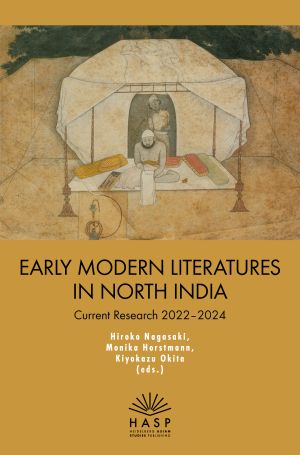
Early Modern Literatures in North India
Current Research 2022–2024
The volume represents the Proceedings of the 14th International Conference on Early Modern Literatures of North India, Osaka University, 15–19 July 2022. It highlights the conference series' history, the influential 1970s manuscript collection foundational to Sant tradition studies, and multilinguality in Jain traditions. It further explores the role of women in court literature, Vedāntic interpretations, the symbolism of paintings in literature, Sūrdās and Gurmukhi cultural outputs, emphasizing the cosmopolitan nature of vernacular literature.
Chapters
Table of Contents
Pages
PDF
PART I - Reviewing the Scope of ICEMLNI
15
PART II - Cosmopolitanism in the Vernacular Ages
31
PART III - Vernacular Vedānta
63
Omission as Interpretive Strategy in Theghnāth’s Gītā bhāṣā
65-90
Bhuvdev Dube’s (Nineteenth-Century) Hindi Translation of Brajvāsīdās’ Braj Bhasha Prabodhacandrodaya nāṭaka (1760)
113-128
PART IV - Female Contribution to the Court Literature
155
PART V - Reflections of Hinduism in Jain Thought
177
An Early-modern Jain Narrative Argumentation concerning Death Rituals
179-197
PART VI - Sūrdās
199
PART VII - Rajasthan
265