

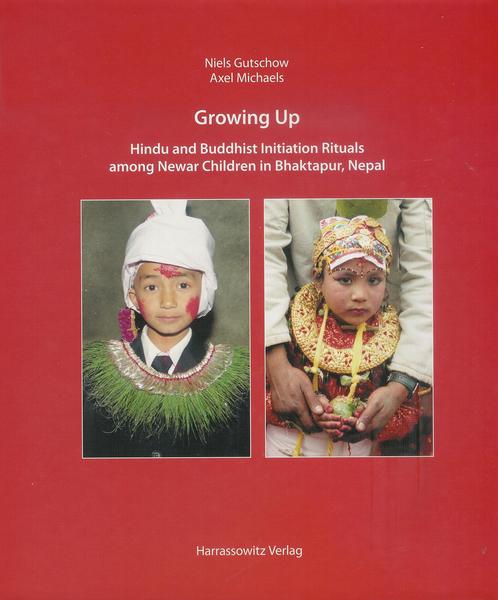
Growing Up: Hindu and Buddhist Initiation Rituals among Newar Children in Bhaktapur, Nepal
The authors – an architectural historian (Niels Gutschow) and an indologist (Axel Michaels) – are presenting the second part of a trilogy of studies of life-cycle rituals in Nepal, carried out under the auspices of the Collaborative Research Centre “Dynamics of Ritual”. The initiation of boys and girls of both Hindus and Buddhists of the ethnic community of Newars in the Kathmandu Valley are documented. The first part of the book presents elements of Newar rituals, the spatial background of Bhaktapur and the hierarchy of ritual specialists – illustrated by 21 maps. The second part documents with detailed descriptions the. rst feeding of solid food, birthday rituals, and pre-puberty rituals like the first shaving of the hair, the boy’s initiation with the loincloth (in Buddhist and Hindu contexts), the girl’s marriage with the bel fruit and the girl’s seclusion. One girl’s marriage (Ihi) and three boy’s initiations (Kaytapuja) are documented on a DVD. The third part presents the textual tradition: local handbooks and manuals used by the Brahmin priest to guide the rituals. Two of these texts are edited and translated to demonstrate the function of such texts in a variety of contexts.
The films, which were originally published on a DVD accompanying the book, are archived in the heidICON multimedia database and can be viewed via the following links:
1. Bel fruit and loincloth - initiations of boys and girls in Bhaktapur, Nepal
2. Bel-Frucht und Lendentuch - Initiationen von Mädchen und Jungen in Bhaktapur, Nepal
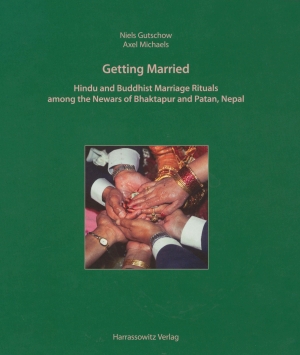
Getting Married: Hindu and Buddhist Marriage Rituals Among the Newars of Bhaktapur and Patan, Nepal
With contributions by Manik Bajracharya, Christiane Brosius, and Tessa Pariyar
Getting Married is the third and final volume on Hindu and Buddhist life-cycle rituals among the Newars of the ancient city of Bhaktapur in Nepal. It combines extensive fieldwork and the edition and translation of relevant ritual handbooks. While Handling Death, the first volume, focussed on the dynamics of death and ancestor rituals, and Growing Up, the second volume, focussed on the rituals of childhood, adolescence and youth (especially the male and female initiation rituals), the present volume deals with a number of rituals related to marriage.
After an introductory overview of studies on marriage rituals in Nepal the authors give some basic marriage rules of Hindu and Buddhist Newars, the social topography and hierarchy, the families of the marriage partners as well as the problems of endogamy and exogamy in Bhaktapur. They present a detailed description of Hindu and Buddhist marriage rituals among Newars (which are partly documented on the DVD included in this book) and come to relevant conclusions regarding life-cycle rituals in general and the place marriage rituals occupy in Newar society and Hinduism. Furthermore the texts used by Brahmin and Buddhist priests during these rituals are edited and translated and complemented by comprehensive Appendices including a list of elements of Newar rituals and mantras as well as a mantra and general index to all three volumes. The richly illustrated books have been highly appreciated by the scholarly community as a unique attempt to provide a comprehensive ethno-indological study of all major life-cycle rituals of a certain Hindu and Buddhist community.
The film, which was originally published on a DVD accompanying the book, is archived in the heidICON multimedia database and can be viewed via the following link:
Getting Married
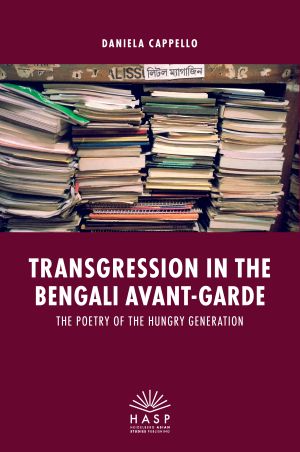
Transgression in the Bengali Avant-garde: The Poetry of the Hungry Generation
Transgression in the Bengali Avant-Garde wants to introduce the Hungry Generation movement to a global audience through its poetry, manifestoes and other literary materials. Emerged from the cities of Patna and Calcutta in the early 1960s, the Hungry Generation gained international attention after the poets' arrest on charges of obscenity in 1964. Fiercely provoking the literary establishment, these Bengali bohemians used poetry and literature as means of cultural radicalism, tackling subjects like sexuality, perversion, alcohol and drug consumption, masturbation, and hyper-masculinity to challenge bourgeois morality and respectability.
The book sheds light on a variety of Hungryalist sources and explores the literature of the Hungry Generation through the filter of 'transgression', showing how this concept unfolded in the language, aesthetics and culture behind this Bengali avant-garde movement. Furthermore, the book will delve into the poetry of some iconic representatives of the Hungry Generation, critically reading their oeuvre in the context of changing models of sexuality, consumption, and modernization in post-colonial India.
Vom Feueraltar zum Yoga: Kommentierte Übersetzung und Kohärenzanalyse der Kaṭha-Upaniṣad
Die Kaṭha-Upaniṣad ist ein vor etwa 2000 Jahren verfasster Sanskrit-Text, der sich mit dem Wesen des Menschen nach dem Tod beschäftigt. Als eine der frühesten Quellen, die eine als Yoga bezeichnete heilseffektive Methode lehren, hat sie auch außerhalb Südasiens Bekanntheit erlangt. Aufgrund ihrer textlichen Heterogenität wurde ihr jedoch schon oft Inkohärenz unterstellt.
In der vorliegenden Studie legt Dominik A. Haas eine neue, kommentierte Übersetzung der Kaṭha-Upaniṣad vor und analysiert sie mit Hilfe textlinguistischer Methoden. Er argumentiert, dass diese Upaniṣad von Anfang an als Kompilation konzipiert war, die neue kontemplative und yogische Lehren mit der Ritualmystik des berühmten vedischen Feueraltars verbinden sollte.
Leisurely Feelings: Emotions and Concepts of Otium in South Asia
This book traces a conceptual history of literature, leisure and emotions in modern South Asia. Reading colonial capitalism as entwined with the ‘myth of the lazy native’, it focuses on vernacular literary contestations in Urdu and Bengali. It foregrounds otium, leisure and idleness as entangled with emotions and temporalities. The book approaches literary spheres through the lenses of emotions, the self, and the community. Literary discourses of otium are analysed in stylistic innovations, negotiations of colonial modernity and postcolonial uncertainties. Highlighting key literary-conceptual expressions, discussions, and processes, the author explores nostalgia, melancholy, topophilia and haunting as emotions deeply attached to South Asian literary cultures while also resonating with concepts of otium across global modernity.
Reviews
Nukhbah Taj Langah in Nidān, Vol. 10, no. 2 (2025)
Jaina Temple Architecture in India: The Development of a Distinct Language in Space and Ritual
Jaina Temple Architecture in India is the first comprehensive study of the development and uniqueness of Jaina sacred structures. The monograph analyses temples in the whole of India and outlines clear continuities by covering the period from the early centuries BCE till the present day. It identifies a distinct Jaina approach to the shaping of ritual space, which involves often complex spatial layouts on various superimposed vertical levels as well as conglomerates of interconnected sanctums and building elements on the horizontal plane. These accommodate a multitude of venerated objects and mirror specific Jaina patterns of worship as well as Jaina mythological and cosmological concepts.
Aktuelle Forschungsbeiträge zu Südasien: 13. Jahrestagung des AK Südasien, 03.-04.02.2023, Eberswalde
Extended Abstracts der 13. Jahrestagung des AK Südasien, 03.-04.02.2023, Eberswalde
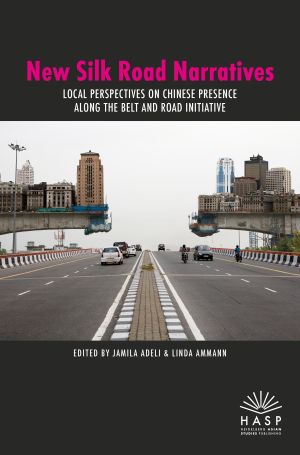
New Silk Road Narratives: Local Perspectives on Chinese Presence along the Belt and Road Initiative
It is not only goods, financial capital or technologies that are being traded, negotiated and circulated along the China-led Belt and Road Initiative but also values, emotions and cultural practices. The latter are often decisive when imagining and establishing a transregional infrastructure of the scale of the BRI. This book explores connections and disconnections along the New Silk Roads through narratives and their cultural configurations. Focusing on China-Africa-relations, the authors of this book investigate the role of narratives and various forms of cultural configurations to understand how processes of transregionalization shape local patterns of thought, perception and practice.
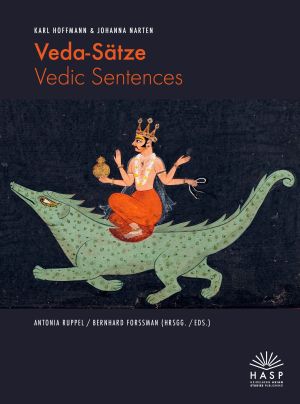
Veda-Sätze – Vedic Sentences
In den altindischen Veden findet man Sätze mit sehr verschiedenen Inhalten, darunter religiöse Aussagen ("Varuṇa ist wahrhaftig der Götter König"), Lebensweisheiten ("Das Denken ist schneller als die Rede") oder auch banale Beobachtungen ("Gattin und Gatte waschen einander den Rücken"). Die bekannten Erlanger Indogermanisten und Indologen Karl Hoffmann (1915-1996) und Johanna Narten (1930-2019) haben bei ihrer jahrzehntelangen Arbeit an den Veda-Texten solche Sätze in der Originalsprache gesammelt. Diese Sammlung von 863 Kurztexten wurde von Antonia Ruppel und Bernhard Forssman zweisprachig (Englisch und Deutsch) mit Übersetzungen und einem vollständigen Vokabular versehen und wird hier erstmals veröffentlicht.
The ancient Indian Vedas contain sentences of rather varied content, including religious statements ("Varuṇa truly is the king of the gods"), words of wisdom ("Thought is quicker than speech") or even banal observations ("Wife and husband wash each other's back"). The well-known Erlangen Indo-Europeanists and Indologists Karl Hoffmann (1915-1996) and Johanna Narten (1930-2019) collected such sentences in the original language during their decades of work on the Vedas. Antonia Ruppel and Bernhard Forssman have furnished this collection of 863 short texts with translations and a complete vocabulary in two languages (English and German) and are publishing it here for the first time.
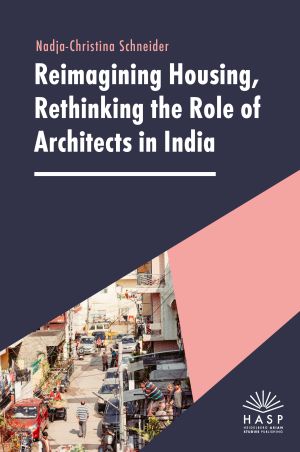
Reimagining Housing, Rethinking the Role of Architects in India
This book explores the self-perception of critical architects in post-independent and contemporary India. It takes particular interest in the role of documentary films and other media forms used by architects to intervene in debates on affordable housing and to share their alternative visions on spatial design and sustainable architecture. As a heterogeneous and highly mobile group of social actors, architects and designers develop and implement viable solutions at the intersection of extremely complex challenges and specific local contexts. The book argues that the interconnections in their design thinking and work can best be understood through the conceptual lens of critical regionalism.
Reviews
Sreya Sen in Doing Sociology (2024)
Suhṛdayasaṃhitā: A Compendium of Studies on South Asian Culture, Philosophy, and Religion. Dedicated to Dominik Wujastyk
The Suhṛdayasaṃhitā is an edited volume dedicated to Dominik Wujastyk that brings together thirteen studies on South Asian intellectual and cultural history from the beginning of the common era to the present day. The multi-disciplinarity and vitality of the academic fields of Indology and South Asian Studies are on full display from chapter to chapter, as leading scholars ask new questions and propose new methods to explore critical topics in their respective fields, including the relationship of the Gāndhāri and Sanskrit languages, bird divination in Indian and cross-cultural contexts, the world view and ethics of early Ayurveda, line drawings in alchemical Sanskrit manuscripts, cannabis in traditional alchemy (Rasaśāstra), deontic logic and terminological problems in Mīmāṃsā and Dharmaśāstra, the identification of an obscure Yoga work referenced in the commentarial literature of the Mahābhārata, psychological transformation and spiritual liberation in Pātañjala Yoga and Buddhism, Sanskrit editorial techniques and the history of printing, the human genome project and the Mahābhārata’s text genealogy, and, finally, the academic pedagogy of contemporary medical anthropology. The time-tested method of analyzing primary sources in Sanskrit and Middle-Indo-Arian languages within their culture-specific historical contexts is fertilized by neuroscience, psychology, evolutionary biology, and anthropology.
In its thematic and methodological diversity, the festschrift, which concludes with a list of Dominik Wujastyk’s works and three indexes, mirrors the broad range of academic interests and expertise of the scholar it is dedicated to.
Mediatised Solidarity: Media Practices of Contemporary Indian Social Movements
In an era marked by rapid media diffusion and globalised social movements, Mediatised Solidarity delves into the evolving dimensions of solidarity within Indian social and protest movements. Focused on the period from 2014 to the present, it analyses the interplay between media practices, including social media, and solidarity expressions. Through three case studies – Shaheen Bagh, the Indian Farmers’ Protest, and contemporary youth climate activism – the book explores how media and visual art shape and are shaped by solidarity and the extent to which shared memories and cultural heritage are used to stage social cohesion.

Sūryās Hochzeit: Kohärenz von Text und Ritual im Ṛgveda (10.85)
Der Ṛgveda ist eine gegen 1000 v. Chr. angelegte Sammlung von gut tausend Sanskrit-Hymnen, die typischerweise einen hochpoetischen Stil aufweisen. Das in dieser Sammlung überlieferte Sūryāsūkta (Ṛgveda 10.85) gilt jedoch als lose strukturierte Zusammenstellung hochzeitsbezogener Strophen.
Im vorliegenden Buch stellt Anne Keßler-Persaud diese grundlegende Annahme zum Textualitätsgrad des Sūryāsūkta in Frage. Mithilfe textlinguistischer und hermeneutischer Verfahren belegt sie eine hohe Kohärenz dieses Textes. Das Sūryāsūkta zeigt eine ausgefeilte metrische und rhetorische Struktur, und kommuniziert auf poetische Weise einen gleichfalls kohärenten Ablauf des Hochzeitsrituals der Göttin Sūryā.
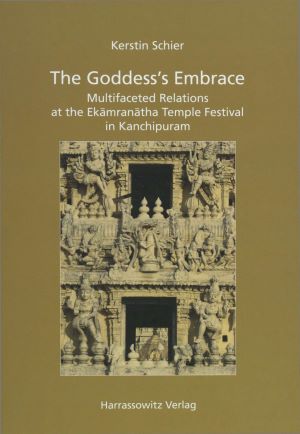
The Goddess’s Embrace: Multifaceted Relations at the Ekāmranātha Temple Festival in Kanchipuram
The study by Kerstin Schier examines the big annual festival (mahotsava) at the Ekāmranātha temple in the South Indian town Kanchipuram, which – among other things – dramatises the divine marriage between god Śiva (as Ekāmranātha) and the goddess, generally considered to be Kāmākṣī.
In the course of the festival’s rituals gods and goddesses, temples, and religious traditions relate to each other in many ways. These complex and multifaceted relations are studied by taking into account different types of historical and contemporary sources, and by combining textual analysis with the observation and study of ritual performances, interviews, and oral narratives.
The book provides a detailed description and analysis of the divine marriage’s contemporary ritual practice and its associated myth in Sanskrit and Tamil texts. It also takes into consideration the different views and interpretations of members of local communities, temple priests, donors, and other participants, which leads to a multiplicity of perspectives on the festival.
Crafting Potency: Sowa Rigpa Artisanship across the Himalayas
Crafting Potency investigates the intricate interweaving of knowledge, practice, and materials through which potency is sculpted in Sowa Rigpa (Tibetan medicine). Informed by Tibetan medical literature and extensive fieldwork with practitioners (amchis) from Ladakh, Dharamsala, and Kathmandu, the authors explore how potency is understood and manipulated in the making of multi-ingredient medicines. Taking inspiration from Tim Ingold’s ecologically attuned phenomenology and Pamela Smith’s concept of “artisanal epistemologies,” potency is presented as efficacy-in-becoming—a fluid capacity sculpted and layered through skilled artisanship, ritual, and environment, rather than a fixed property of stable substances. Highlighting the deep immersion of amchis in their social, ecological, technical, and spiritual lifeworlds—and exploring what changes when knowledge is transmitted through institutional rather than lineage-based training—the book contributes nuanced practice-based perspectives to the anthropology of craft and the history of science.
Among Tibetan Materialities: Materials and Material Cultures of Tibet and the Himalayas
Among Tibetan Materialities makes an intervention into Tibetan studies by critically engaging with material culture. It opens up new sources, methodologies and frameworks for studying, thinking and writing about material culture, materials and materiality in Tibet and the Himalayas. It highlights novel ways that Tibetan and Himalayan worlds can be made relevant beyond their local contexts. Spanning historical and contemporary contexts this collection of ongoing research disrupts current approaches to Tibetan and Himalayan materiality by considering socially constructed materiality and the materials constituting things, from their conception and production to their end of life and afterlife.

Aktuelle Forschungsbeiträge zu Südasien: 14. Jahrestagung des AK Südasien, 02.-03.02.2024, Augsburg
Extended Abstracts of the 14th Annual Meeting of the AK Südasien, 02.-03.02.2024, Augsburg

Here and Elsewhere: Transposed Deities, Substitute Pilgrimages and Geographic Imagination in North India
Here and Elsewhere offers a grounded study of crucial modes of sanctification and imagination of Hindu geographies: spatial transposition and substitute pilgrimage. It looks at the local representatives of the pan-Indian jyotirliṅgas in Varanasi (Banaras) and the urban pilgrimage connected to them by combining interpretative analysis of glorifications (māhātmyas) with in-depth ethnographic research. This enables the author closely to observe the strategies that a variety of social actors employ to knit together and reproduce connections between places of the here and the elsewhere, and to locate deities and themselves within multiple spatial dimensions, both lived and imagined.
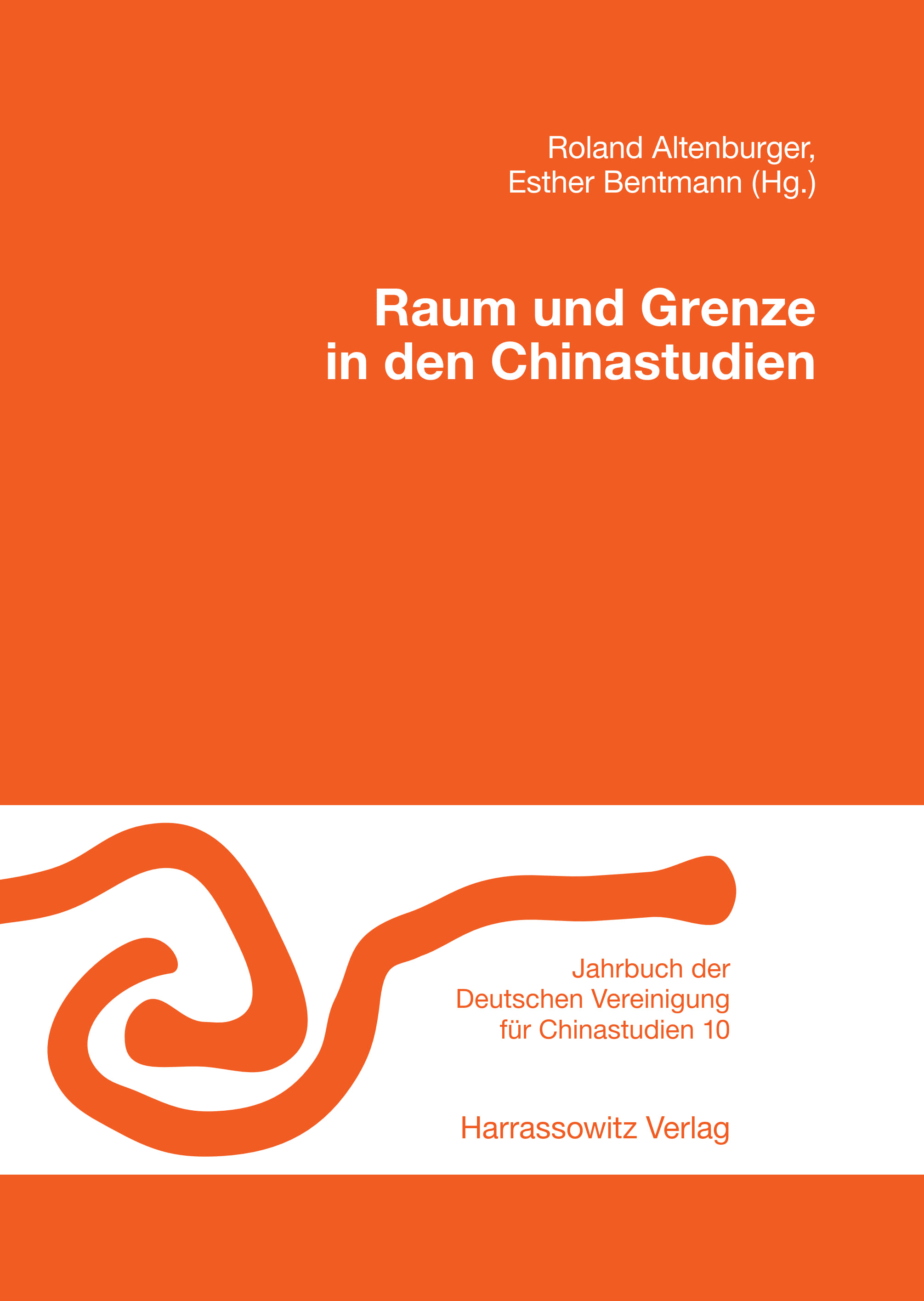
Raum und Grenze in den Chinastudien
Die im November 2013 an der Julius-Maximilians-Universität Würzburg durchgeführte XXIV. Jahrestagung der Deutschen Vereinigung für Chinastudien widmete sich dem Thema „Raum und Grenze“. Sie lud zur Auslotung des Erkenntnispotenzials einer Hinwendung zum Raum, eines spatial turn in der chinabezogenen Forschung ein. Neben Beiträgen mit dem eher konventionellen Ansatz von Raum und Grenze als Territorialität wurden auch Untersuchungen zu Raum als sozialer Konstruktion vorgestellt, wobei Praktiken der Raumkonstitution, -erschließung und -beherrschung sowie Akte der Ein- und Ausgrenzung eine wichtige Rolle spielten.
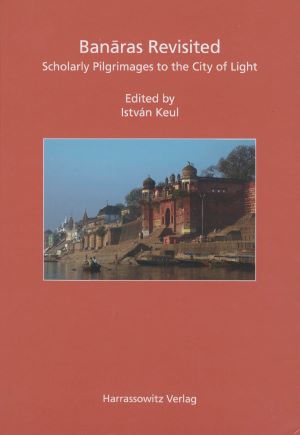
Banāras Revisited: Scholarly Pilgrimages to the City of Light
In Banaras Revisited, scholars from various disciplines talk about their research in a city that has been described as a veritable microcosm of India: multifaceted, complex, vibrant, and full of contradictions. The themes range from the sensory aesthetics of everyday life to the history of the Marathas in Banaras; from Harishchandra, the father of modern Hindi, to the tribals of Nagwa; from the architecture of the ghats to the works of the Austrian writers Zweig and Winkler; from informative relationships with research assistants to the mediatization of goddesses; from reflections on public education to a contemporary literary chronicler of Assi; from colonial ghosts in the 1950s to present-day Western travelers. In addition to its thematic diversity, the volume benefits from another strong asset: the voices of its contributors, clearly audible in reflexive passages and personal vignettes that make the essays a useful reading also for undergraduates considering fieldwork in Banaras or elsewhere.
Harmonie und Konflikt in China
Im Diskurs über China, ein Land, das nach Ansicht vieler Beobachter im Zeichen der Harmonie steht, wird der Aspekt des Konflikts oft unterbelichtet. Dabei sind sowohl soziale Spannungen als auch geistige Kontroversen im chinesischen Kulturraum von jeher allgegenwärtig und erweisen sich – im Altertum wie in der Moderne – als maßgebliche Kraft für den kulturellen Wandel sowie die moderne Gesellschaftsentwicklung. Konflikt und Harmonie stehen sich dabei nicht notwendigerweise unvereinbar gegenüber, sondern befinden sich oft in einem Symbioseverhältnis, welches sich im Wechselspiel zwischen Freiheit und Unterdrückung manifestiert.
Im Spannungsfeld zwischen Konflikt und Harmonie lassen sich viele Probleme aus dem Geistes- und Gesellschaftsleben Chinas aufspüren und analysieren. Die Autorinnen und Autoren der 15 Beiträge dieses Bandes beleuchten Fragestellungen aus der Perspektive unterschiedlicher auf China bezogener Forschungsbereiche wie Philosophie, Literatur, Soziologie, Politologie, Rechtswissenschaften und Geschichte.
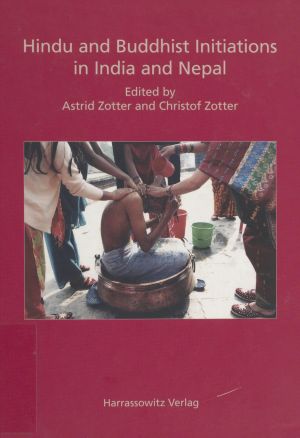
Hindu and Buddhist Initiations in India and Nepal
Broadly speaking, two sets of rituals are relevant to a discussion of initiations in Hindu and Buddhist traditions: initiatory rituals as part of the life-cycle which are observed in many social groups and are compulsory depending on gender or age, and those, more optional in character, that allow admittance to a certain religious group or practice. The contributors to this volume are from different academic disciplines and treat examples of both kinds of rituals in various religious settings. Of special interest in this collection of essays are interrelationships among initiations and their relations to other kinds of rituals. The papers are devoted to the study of minute details and point to the dynamics of initiations. The transfer of ritual elements accompanied by readjustments to new contexts as the modification of procedures or the reassignment of meanings is one of the recurring traits. Other aspects addressed by the authors include the relation of script (ritual handbooks) to performance or various forces of change (e.g. the economics of ritual, gender-related variations, modernization and democratization).
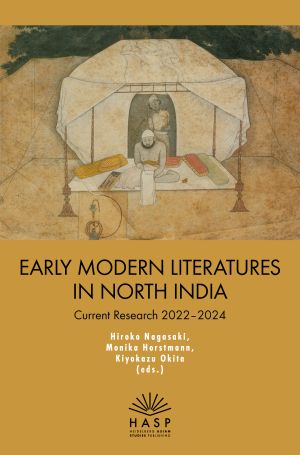
Early Modern Literatures in North India: Current Research 2022–2024
The volume represents the Proceedings of the 14th International Conference on Early Modern Literatures of North India, Osaka University, 15–19 July 2022. It highlights the conference series' history, the influential 1970s manuscript collection foundational to Sant tradition studies, and multilinguality in Jain traditions. It further explores the role of women in court literature, Vedāntic interpretations, the symbolism of paintings in literature, Sūrdās and Gurmukhi cultural outputs, emphasizing the cosmopolitan nature of vernacular literature.
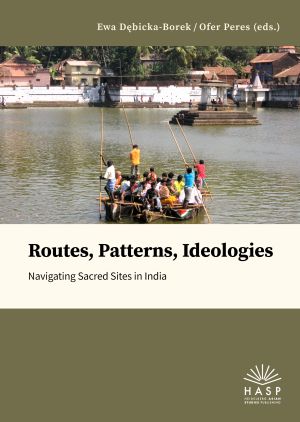
Routes, Patterns, Ideologies: Navigating Sacred Sites in India
Hindu sacred geographies are shaped by interwoven webs of myth, ritual, and pilgrimage. Routes, Patterns, Ideologies: Navigating Sacred Sites in India brings together essays that offer in-depth explorations of Hindu sacred spaces, focusing on the relationships between sites as a crucial dimension of their theological and social significance. Drawing on textual analysis, visual studies, and ethnographic insights, the contributors to this volume illuminate the patterns and mechanisms that link sacred sites into dynamic networks, demonstrating how sacrality is continually negotiated through evolving cultural, political, and theological landscapes.
Wissensorte in China
Alles Wissen hat seinen Ort. Die Räume, in denen Wissen hervorgebracht, gespeichert oder weitergegeben wird, üben konkreten Einfluss auf deren Inhalt und Form aus. Im Zuge des spatial turn sind Fragen nach den örtlichen Bedingungen von Wissen deshalb in den Fokus verschiedener geistes- und sozialwissenschaftlicher Disziplinen gerückt: Welche Orte spielen bei der Sammlung und Interpretation von Wissen eine prägende Rolle? Wie beeinflussen räumliche Bedingungen Theorien und Verfahrensweisen? Welche ortsspezifischen Formen und Medien werden benutzt, um Wissen zu bewahren oder weiterzugeben? Und welche Relevanz hat der räumliche Bezug für die Gültigkeit des Wissens?
Wissensorte in China geht diesen Fragen in elf Fallstudien und einem Überblicksartikel nach. Die Beiträge spannen einen zeitlichen Bogen von der Han-Zeit bis zur Gegenwart. Sie untersuchen räumliche Dimensionen von Institutionen der höheren Bildung und Stätten der beruflichen Aus- und Weiterbildung, rekonstruieren kommerzielle und religiöse Orte wie Bücherboote und buddhistische Bücherräder, analysieren aber auch Texte und soziale Praktiken, die sich als Wissensorte eigener Art verstehen lassen. Die Artikel gewähren damit faszinierende Einblicke in eine der weltweit reichsten Wissenskulturen.
Der Band enthält ausgewählte Beiträge zur XXX. Jahrestagung der Deutschen Vereinigung für Chinastudien (DVCS), die im November 2019 am Centrum für Asienwissenschaftliche und Transkulturelle Studien (CATS) der Ruprecht-Karls-Universität Heidelberg stattfand.
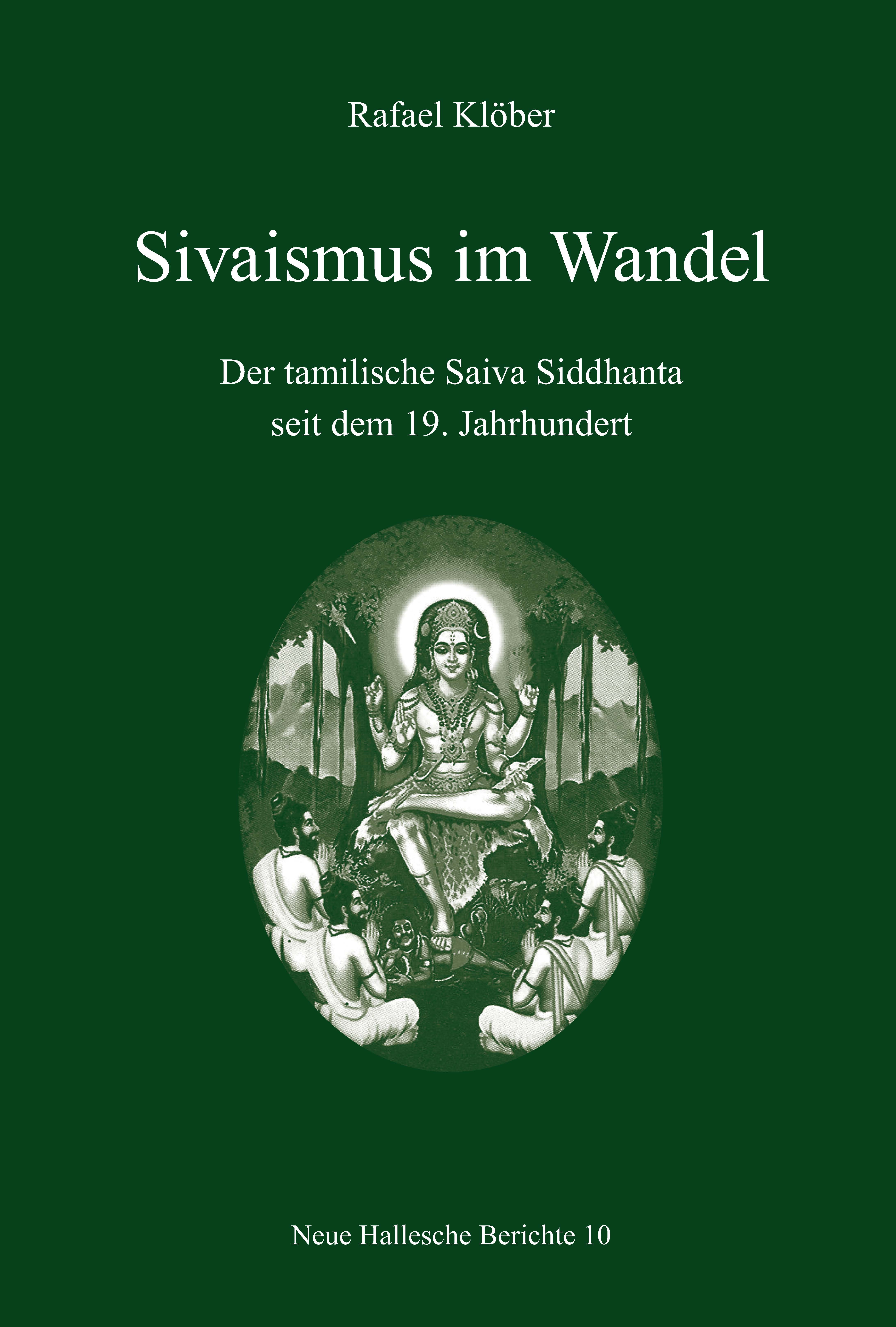
Sivaismus im Wandel: Der tamilische Saiva Siddhanta seit dem 19. Jahrhundert
Ausgangspunkt dieser Untersuchung über die philosophische Tradition des Saiva Siddhanta ist eine ethnographisch-philologische Analyse von deren tamilischen Ausprägungen und der Lehren ihrer einflussreichsten Wortführer zu Beginn des 21. Jahrhunderts. Dabei orientiert sich die Studie am bedeutendsten monastisch-orthodoxen Zentrum des tamilischen Saiva Siddhanta, dem Thiruvavaduthurai Adhinam. Durch ihre Öffnung für Laien seit den 1990er Jahren verbreitet diese Einrichtung die philosophischen Lehren durch eine eigene populäre Organisation und bestimmt maßgeblich die südindischen Debatten.
Die Untersuchung verfolgt dieses gegenwärtige Verständnis der tamilisch-sivaitischen Philosophie historisch bis in die Mitte des 19. Jahrhunderts zurück. Dabei wird deutlich, dass die Konzeption des Saiva Siddhanta um 1900 einschneidende Brüche erfahren hat und sich daraus bis heute einflussreiche Namensgebungen entwickelt haben. Es wird also gezeigt, dass der tamilische Saiva Siddhanta mit seinen philosophischen Grundannahmen und literarischen Kanones das Ergebnis einer globalen Verflechtungsgeschichte darstellt, die von tamilischen Gelehrten, sivaitischen Reformern, christlichen Missionaren und europäischen Orientalisten gemeinsam geprägt wurde.

Ranbir Singhs Juwelenbrosche und Aigrette: Einleitung und Edition
Band 1 dokumentiert erstmals mit einer Teiledition von 19 Kapiteln den überlieferungskritisch am besten abzusichernden Textbestand dieses Sanskritwerks. In der begleitenden Einleitung werden die historischen Umstände des Texttransfers aus dem Neupersischen ausgeleuchtet. Durch Bestimmung der Übersetzungsmethode sowie einer umfassenden Darstellung der Übersetzungsverfahren Sāhibrāms wird mit vielen Beispielen und Übersichten aufgezeigt, wie Muḥsins Ethik schließlich zu Ranbir Singhs Turbanschmuck wurde.
Der edierte Sanskrittext sowie eine diplomatische Transkription des Haupttexts der nicht edierten Kapitel wurden als Forschungsdaten veröffentlicht. Diese stehen zum Download zur Verfügung unter: https://doi.org/10.11588/DATA/LTF9NA
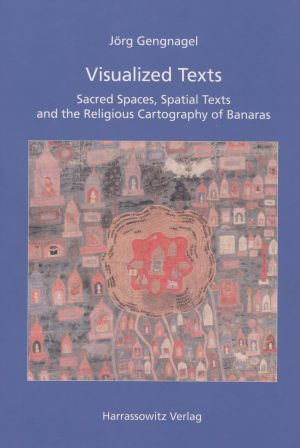
Visualized Texts: Sacred Spaces, Spatial Texts and the Religious Cartography of Banaras
The study of the history of South Asian cartography has long been interpreted based on Western cartographic traditions. Maps of the South Asian subcontinent were assumed to be produced by foreigners – not by South Asians themselves. Maps actually produced in South Asia were neglected as a category in their own right. The present study focuses on the religious cartography of the north Indian pilgrimage center Banaras (Varanasi). It deals with visualizations of the sacred topography of Banaras as represented by various kinds of “maps”, including painted pictorial maps, printed pilgrimage maps and simple spatial charts. The introduction to the volume is followed by a study of the textual background of the studied cartographic material. It then presents a nineteenth century debate on the Pancakroshi procession as a case study on the interrelation of maps, texts and pilgrimage practice. The following section presents the first detailed study of four pilgrimage maps produced during the 18th and 19th century. The volume concludes with extensive indices that provide access to the numerous names of gods, places and temples contained in the studied maps, texts and processions.

Ranbir Singhs Juwelenbrosche und Aigrette: Übersetzungen und Anhänge
Band 2 erschließt durch die deutsche Übersetzung des metrischen Grundtexts mit zahlreichen Ergänzungen aus dem Autokommentar diesen Text auch inhaltlich. Dieser Übersetzung sind die korrespondierenden Passagen der persischen Vorlage zugeordnet — ihrerseits in deutscher Übersetzung. Darauf folgen zahlreiche Anhänge, welche die intertextuellen Bezüge zusammentragen, das metrische Repertoire Sāhibrams aufzeigen und seine Figurengedichte bildlich darstellen. Auch der lexikalisch bisher nicht erfasste Teil seines Wortschatzes findet sich dort verzeichnet.
Der edierte Sanskrittext sowie eine diplomatische Transkription des Haupttexts der nicht edierten Kapitel wurden als Forschungsdaten veröffentlicht. Diese stehen zum Download zur Verfügung unter: https://doi.org/10.11588/DATA/LTF9NA

Kleines Gatha-Lesebuch: Aus dem Nachlass herausgegeben von Bernhard Forssman, unter Mitwirkung von Jürgen Habisreitinger. Mit einem Beitrag von Almut Hintze.
Dieses Buch enthält Stücke aus den "Gathas": poetischen Texten, als deren Verfasser Zarathustra angesehen wird, der Stifter der Parsen-Religion. Die Sprache dieser Dichtungen ist eine frühe Stufe des Avestischen, einer Schwestersprache des Altpersischen im alten Iran. Die sprachliche und inhaltliche Deutung der Gathas stößt auf zahlreiche Schwierigkeiten. Der bedeutende Avesta-Forscher Prof. Karl Hoffmann (1915 - 1996) legte sich für seinen Unterricht eine Sammlung von verhältnismäßig einfachen Textstücken mit eigenen Übersetzungen an. Diese Sammlung wird nunmehr aus seinem Nachlass herausgegeben, erweitert um verschiedene Beigaben, u.a. um einen Beitrag von Prof. Almut Hintze (London) über die Gathas und um ein vollständiges Vokabular.

Krise und Risiko: China und der Umgang mit Unwägbarkeit
In Zeiten von weltweiten Pandemien, unerwarteten Kriegen und zunehmenden gesellschaftlichen Spaltungen existiert in vielen Gesellschaften deutlicher denn je zuvor im 21. Jahrhundert ein Bewusstsein von „Krise“. Über lange Jahrzehnte unhinterfragte politische, soziale und kulturelle Gewissheiten sind unübersehbar ins Schwanken geraten. Nicht nur im deutschsprachigen Raum und in Europa zwingt dies zu einer Neuverhandlung des Umgangs mit Unwägbarkeiten, nicht zuletzt im Verhältnis zu China.
Der Band Krise und Risiko präsentiert ausgewählte Beiträge zur XXXI. Jahrestagung der Deutschen Vereinigung für Chinastudien (DVCS), die im November 2020 vom Asien-Orient-Institut der Universität Zürich organisiert und coronabedingt virtuell durchgeführt wurde. Die elf Beiträge des Bandes beschreiben einen Bogen, der von der Bewältigung der Corona-Pandemie in der Volksrepublik China des Jahres 2020 über Katastrophenmotive in der populären Erzählliteratur der Ming-Zeit bis zum Topos der Selbsttötung aus Protest als vermeintliche Strategie zur Überwindung persönlicher Krisen in philosophischen Texten des Altertums reicht. Sie beleuchten dabei nicht nur verschiedene Perioden, geographische und gesellschaftliche Bereiche in China, sondern eröffnen ein weites Panorama von methodischen Zugriffen, schriftlichen und mündlichen Quellen, und analysieren die mit ihnen verbundenen sozialen, künstlerischen oder auch religiösen Praktiken und Wissenskulturen.
Aktuelle Forschungsbeiträge zu Südasien: 3. Jahrestagung des AK Südasien, 25./26. Januar 2013, Heidelberg
Extended Abstracts der 3. Jahrestagung des AK Südasien, 25./26. Januar 2013, Heidelberg.
Aktuelle Forschungsbeiträge zu Südasien: 4. Jahrestagung des AK Südasien, 24./25. Januar 2014, Freiburg
Extended Abstracts der 4. Jahrestagung des AK Südasien, 24./25. Januar 2014, Freiburg.
Aktuelle Forschungsbeiträge zu Südasien: 5. Jahrestagung des AK Südasien, 23./24. Januar 2015, Göttingen
Extended Abstracts der 5. Jahrestagung des AK Südasien, 23./24. Januar 2015, Göttingen.
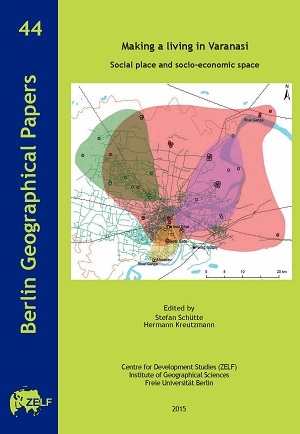
Making a living in Varanasi: Social place and socio-economic space
The three-semester long project was implemented in Varanasi in close cooperation with Prof. Rana PB Singh and his colleagues and students from the Department of Geography at Banaras Hindu University and with the help of a number of established contacts in the city. We could form nine mixed groups of people with local knowledge and orientation that paired with a couple of students each from the Berlin team. The thematic focus was directed on ‘Making a living in Varanasi – social place and socio-economic space’. Beyond Varanasi’s attraction as a holy pilgrimage destination and place for worship we primarily looked at professions and locations that provide opportunities for making a meagre living by hard work. Consequently, certain trades and professions, groups and communities, individuals and office-bearers who kindly allowed us to observe, follow and sit with them during their working hours and to visit them at home contributed to form a selective mosaic of living conditions in Varanasi. All nine contributions in this volume are based on the findings from these joint-endeavours that were regularly discussed and re-adjusted during our bilateral discussions and plenary meetings at night in our temporary home in Varanasi. During a follow-up seminar back in Berlin the outcomes and results were again refined and processed to such a state that we could prepare the manuscripts in a manner that they fulfilled the formal requirements which a scientific journal would demand for.
Between Exploitation and Economic Opportunity? Identities of Male Nepalese Labor Migrants in the Gulf Region
In light of the upcoming FIFA world championship in Qatar, increasing international attention has turned to the large role of foreign workers in the rapid growth of many Gulf cities, as well as the often problematic working and living conditions of these laborers. Considerably less attention, however, has been given to the ‘other ends’ of those migration processes, namely the contexts from which these people originate and return to. One of these contexts is in Nepal, where hundreds of thousands of migrants leave the country each year in search of so-called low-skilled employment. In light of Nepal’s considerably small population and weak economy, these practices have an enormous impact on the country – both financially and in terms of the social and cultural transformations that go along with them. The thesis investigates how these mostly male migrants and their families navigate through transnational lifestyles and how their identities are transformed alongside them. By drawing on qualitative empirical research conducted in 2012, particular focus is put on the re-definition of relationships and intimacy in transnational family practices and the often conflictual and fragmented negotiation of migrant identities. Thereby, the publication provides not only insights into a particular Nepalese practice, but also contributes to the increasingly influential field of critical migration research.
Die Revitalisierung von Vāstuvidyā im kolonialen und nachkolonialen Indien
Vāstuvidyā, die altindische esoterische Lehre vom Hausbau, ist seit der ersten Hälfte des 20. Jahrhunderts Gegenstand verschiedener Wiederbelebungsversuche gewesen. Dieses Buch untersucht diese Bestrebungen im Kontext ideologischer und geistesgeschichtlicher Entwicklungen mit den Methoden der Textanalyse. Das Verhältnis der revitalisierten Version(en) von Vāstuvidyā zu den vorkolonialen vāstuśāstras, ebenso die Relevanz der Apologetik der einheimischen Wissenschaften für die Revitalisierung von Vāstuvidyā sowie die Diskursstrategien, die im revitalistischen Vāstu-Schrifttum zur Anwendung kommen, bilden die zentralen Themen des Buches.
Rezensionen
Rezension von Felix Otter: Revitalisierung von Vāstuvidyā im kolonialen und nachkolonialen Indien. Heidelberg: CrossAsia-eBooks, 2016. Rezensiert von Simon Cubelic für H-SOZ-Kult, 06.07.2018.
Sreeramula Rajeswara Sarma: The Growing Influence of "Vāstuśāstra" in India. Rezension von: Felix Otter: Revitalisierung von Vāstuvidyā im kolonialen und nachkolonialen Indien. Heidelberg: CrossAsia-eBooks, 2016. In: Orientalistische Literaturzeitung 115 (2), 2020: 97-102.
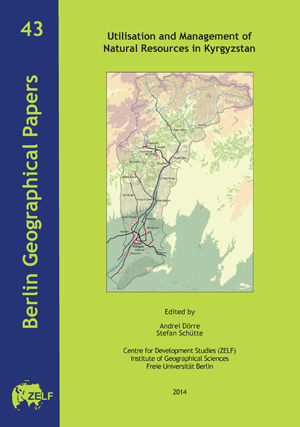
Utilization and Management of Natural Resources in Kyrgyzstan
The training of students in the Department of Geography at the Centre for Development Studies (ZELF) of the Freie Universität Berlin includes the scientific preoccupation with theories of development, with social inequalities at multiple scales reaching from global to local arenas, and with questions of international development policies and practices aimed to ensure basic needs and sustainable development. (...) Following this approach, the project in 2013 was dedicated to specific issues of Kyrgyzstan’s development after 1991. The rural population of the post-socialist society depends to a great extent on the utilisation of natural resources, and the project focused primarily on the use and the management of natural resources that occur in the context of development efforts of governmental and non-governmental institutions.
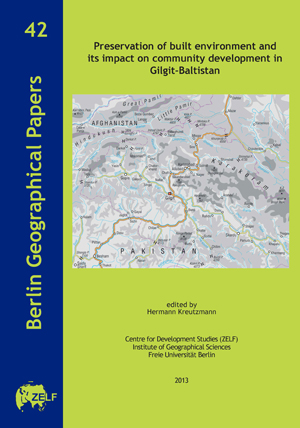
Preservation of built environment and its impact on community development in Gilgit-Baltistan
The study presented here is the outcome of a mission on behalf of the Aga Khan Cultural Services Pakistan to Gilgit-Baltistan in September 2009. The linkages between cultural preservation and the restoration of historical monuments and their impact on regional economies, skill development and tourism were to be analysed by two independent researchers: Hermann Kreutzmann and Jolyon Leslie.
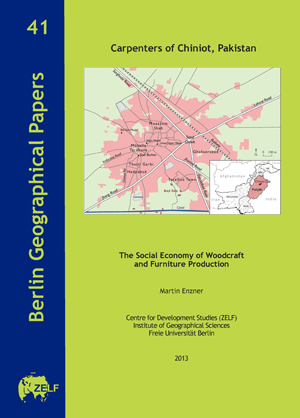
Carpenters of Chiniot, Pakistan: The Social Economy of Woodcraft and Furniture Production
The combination of the artisanal heritage, the existence of a contemporary large-scaled carpentry and woodcraft cluster and the phenomenon of carpentry being the prevalent occupation in the city, makes Chiniot an interesting case for an historical comparison of the socio-economic conditions of carpenters in society. Additionally, the topic of caste in a Muslim country like Pakistan is deserving of attention. The basic research questions underlying this paper are:
• Which economic processes influenced the carpenters’ lives during the British period?
• How was the socio-economic condition of Chinioti (respectively Punjabi) carpenters
constituted in the past, with emphasis on their caste identity during the British colonial period?
• What are the main characteristics of furniture production and marketing in Chiniot today? What implications does the production system have for the local carpenters
and their income perspectives?
• How is the socio-economic condition of Chinioti carpenters constituted today?
• Which defining features of the caste society were subject to change and what does it
mean for carpenters?
This paper is an attempt to better understand the lives of the “unknown carpenters” in the past as well as in the present. It is a sociogeographic analysis of Chinioti carpenters embedded in an analysis of the current nature of the local furniture cluster which frames their livelihoods.
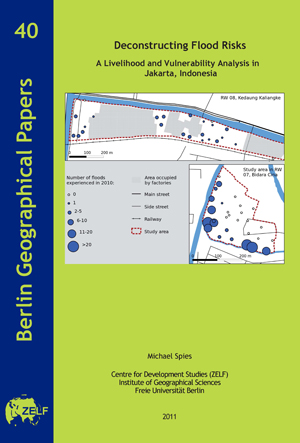
Deconstructing Flood Risks: A Livelihood and Vulnerability Analysis in Jakarta, Indonesia
“Flooding is the least of the problems, it is a usual thing.”
“We are not afraid of floods, we are used to them.”
— Interviewees in East Jakarta, December 2010
Statements like the above were given by several residents in neighbourhoods of Jakarta that are often described as being “most vulnerable” to flood hazards. (...) Is it possible that such disasters are just a minor issue for the supposedly most affected? Or are the above statements the result of subconsciously repressed disaster memories, or some kind of fatalism?
In Jakarta, several community-based projects on flood risk reduction emerged in recent years. These projects can be interpreted as responses to the growing emphasis on bottomup, community-based approaches in the international research and policy community on disaster risk reduction. Organisations such as MerciCorps and UNESCO implemented projects that aim to strengthen local capacities of flood risk reduction in Jakarta’s most affected neighbourhoods. Typical project measures are awareness campaigns on solid waste issues, the strengthening of local disaster management and small-scale, physical measures of flood mitigation.
However, considering the introductory quotes above, the legitimacy of these projects — or at least of its labelling as “community-based” and “bottom-up” — comes into question. If flooding is not seen as a problem in Jakarta’s most affected neighbourhoods, these projects appear to miss the point. In other geographical contexts, scholars criticised that humanitarian organisations look through a “disaster lens” in their community assessments and tend to neglect local risk priorities when implementing community-based projects.
Thus, the aim of this paper is to find out what is behind the apparently low priority of flood risk for the supposedly most affected people — an underrated issue in the research literature on flood or disaster risk reduction. The overall research question is therefore: Is flooding a minor problem for the most affected households in Jakarta?
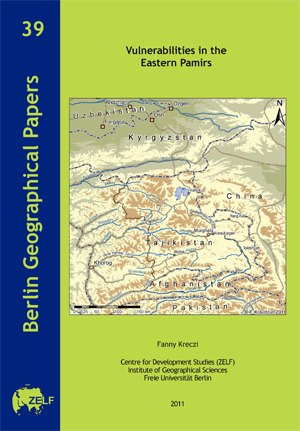
Vulnerabilities in the Eastern Pamirs
The present study is concerned with sustainable livelihoods and the effects of development cooperation with regard to their improvement and optimization in the Eastern Pamirs. In order to present the complexity of poverty and the influence that the development cooperation bears on sustainable livelihoods in the region, the author deals with the following questions:
- How does the complexity of poverty present itself in the local context of the high mountains in the southern countries?
- What is the potential contribution of international organisations with respect to an improvement of sustainable livelihoods?
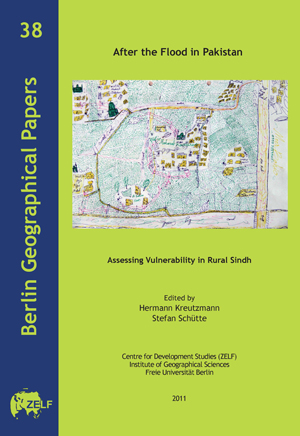
After the Flood in Pakistan: Assessing Vulnerability in Rural Sindh
After the devastating floods of August-September 2010 had destroyed the living abodes and detrimentally affected the basic resources of several million people in Pakistan, the subsequent relief operations were supposed to be terminated half a year later. By March 2011 a new phase with coordinated steps for mid-term rehabilitation and long-term development activities were envisaged. The way forward posed a major challenge. (...)
The report presented here draws the attention to one of the least-studied regions of Pakistan and to three districts in Sindh Province. The report covers eight villages in Sindh's Badin, Dadu, and Thatta districts. The selection of villages is strongly linked to the initiators and sponsors of this independent research project. The German Red Cross (GRC) and the Pakistan Red Crescent Society (PRCS) suggested to the Centre for Development Studies at Freie Universität Berlin to cooperate again - after a successful joint evaluation of development packages in Kashmir in 2009 (see volume 36 of this series) - in an assessment in Sindh Province. This time, the terms for the assessment followed a different rationale in involving the independent academic supporters. (...)
The objectives were wide-spread and far-reaching: First, to gain some insight into the socio-economic situation of rural communities in a wider setting of their districts, in their relationship to developments in Sindh province and within Pakistan. Second, to analyse the social set-up in rural Sindh in terms of vulnerability and exposure to risk. Third, to assess the impact the recent floods had on the livelihoods of households in the village settings. Fourth, to formulate recommendations for implementation of project packages. (...) The result of our work is presented in this report.
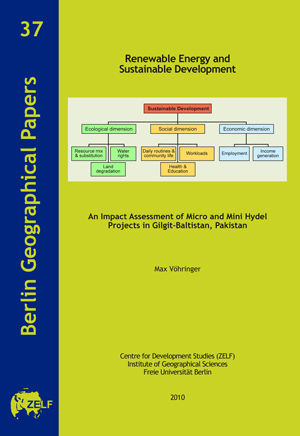
Renewable Energy and Sustainable Development: An Impact Assessment of Micro and Mini Hydel Projects in Gilgit-Baltistan, Pakistan
The Clean Development Mechanism (CDM) is a policy instrument that aims to take into account the climate development nexus. It is part of the global climate regime of the Kyoto protocol, in which most of the so-called developed countries of the world committed to reduce their GHG emissions by 5.2% below the level of 1990 until 2012. The CDM includes the developing countries in the regime by allowing developed countries to comply with their reduction commitments through the support of renewable energy projects in developing countries. The dual objective of the instrument – as laid down in article 12 of the Kyoto protocol – is to support developed countries in complying with their emission targets and to assist the developing countries in achieving Sustainable Development. There are no internationally standardized guidelines for the Sustainable Development objective but it is the host party’s responsibility to define, assess, and monitor the respective criteria.
At its initiation in 1997, the CDM was widely welcomed with high expectations for its ability to stimulate developmental benefits. By 2010, the CDM has been a great success in terms of the high quantity of projects being implemented, but has been criticised for various qualitative reasons. One of the areas of concern is that CDM projects often neglect the goal of fostering Sustainable Development on the project level and only rarely address the poorest segments of the population directly and appropriately. In order to test this hypothesis, processes on the local project level have to be analysed. What benefits are in fact created by the renewable energy projects initiated on the global climate policy level, and which of these actually impact the individual? It is the objective of this paper to investigate these questions through assessing the impact of three exemplary projects realized under the CDM.
The examples presented are small-scale hydro power plants implemented by the Aga Khan Rural Support Programme (AKRSP), a non-governmental development organisation, in Gilgit-Baltistan in the north of Pakistan. Thus far, most of the local energy demand is met by the use of biomass and fossil fuels. By implementing so-called run-of-river hydro power plants that, in contrast to larger hydro power stations, have no storage reservoir, AKRSP aims to improve the deficient access of the region’s rural population to electricity. The plants have capacities ranging between 35 and 600 kW and are also referred to micro and mini “hydels”. Comparable projects have been implemented in the high mountain region for many years. Through their promotion by the CDM they are now gaining increased prominence on the global level.
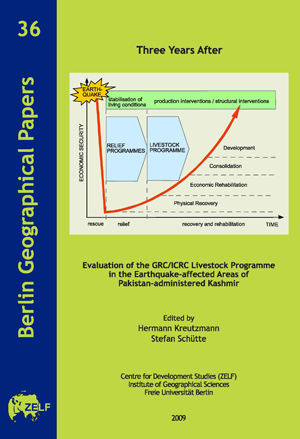
Three Years After: Evaluation of the GRC/ICRC Livestock Programme in the Earthquake-affected Areas of Pakistan-administered Kashmir
Three years after the devastating earthquake in Pakistan-administered Kashmir most relief and development programmes have gradually cut down their activities to help local communities recuperate from the disaster. In the immediate aftermath of the October 8th, 2005 earthquake a number of national and international relief organisations engaged in activities to support local communities. These activities have only rarely been evaluated to determine whether they had a mid-range or longer-lasting impact on the livelihoods of the affected people.
The report presented here is the result of an impact assessment of a livestock project implemented in the earthquake affected areas by the German Red Cross (GRC) in collaboration with the International Committee of the Red Cross (ICRC). This assessment was a joint effort of the relief and development activities executed by GRC/ ICRC, and academia from the Centre for Development Studies in the Institute of Geographic Sciences at Freie Universität Berlin. The participatory evaluation involved experienced staff from the Red Cross and representatives of village communities from the four Union Councils in Muzaffarabad District that were severely affected by the earthquake. Both acted as valuable knowledge resources, interpreters and mediators in focus group discussions and expert interviews that were conducted during the three weeks of fieldwork between March 18 and April 2, 2009. (...)
The prime objective of this joint programme was to evaluate the impact of a livestock package that intended to augment the livelihoods and provide a resource base for families affected by the earthquake, going beyond sheer disaster relief efforts and moving towards more sustainable development. The second objective was to identify achievements and short-comings of the livestock package in order to identify lessons-learned for future economic and social programmes in the context of post-disaster interventions.
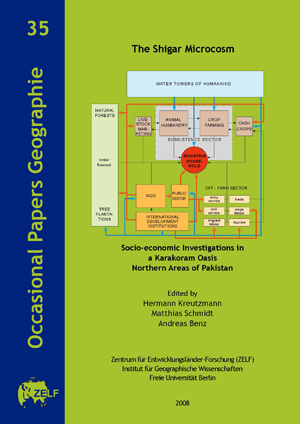
The Shigar Microcosm: Socio-economic Investigations in a Karakoram Oasis Northern Areas of Pakistan
Shigar is located in the Central Karakoram, where the residents make a living based on a combination of crop farming and animal husbandry. Because of the high mountain environment and the arid climatic conditions reflected in sparse natural vegetation cover agricultural activities face significant challenges when survival on local resources is attempted. Previous investigations and studies have described the livelihood conditions and agricultural strategies adopted in the Shigar oasis. The so-called combined mountain agriculture applied here is similar to farming strategies which can be observed in the Hindu Kush, Karakoram and Himalaya.
In Shigar, the utilisation of irrigated land plays an important role within the livelihood strategies of the local people. In our study we follow the question: “In which way did land use change during the last decade?”
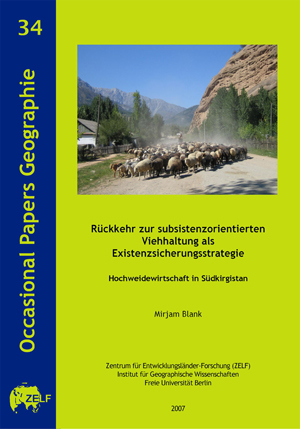
Rückkehr zur subsistenzorientierten Viehhaltung als Existenzsicherungsstrategie: Hochweidewirtschaft in Südkirgistan
Mit dem Ende der UdSSR wurden politische und wirtschaftliche Transformationsprozesse ausgelöst, deren Auswirkungen die Menschen in den betroffenen Ländern, darunter auch Kirgistan, stark zu spüren bekamen. Die mit der Transformation verbundene Privatisierung staatlicher Agrarbetriebe und die Erosion staatlicher Sicherungssysteme bewirkten besonders auf dem Land eine gravierende Änderung der bisherigen Lebensumstände, da gewohnte Arbeits- und Einkommenssicherheiten schlagartig an Bedeutung verloren und die Bevölkerung plötzlich für ihre Lebensunterhaltssicherung selbst verantwortlich wurde. Bei der Suche nach geeigneten Strategien zur Existenzsicherung kommt es seitdem verstärkt zu einem Rückgriff auf bewährte Wirtschaftspraktiken.
Im Zentrum des Interesses dieser Studie stehen die Menschen, die in einem abgelegenen Hochgebirgsraum leben und – auf den politisch-wirtschaftlichen Systemwande völlig unvorbereitet – eine neue Überlebensstrategie einschlagen mussten. Ein Anliegen ist es, die Handlungsmotive dieser Menschen zu verstehen, die sich aus der sozioökonomischen Lebenssituation und der Beschaffenheit des Naturraums ergeben.
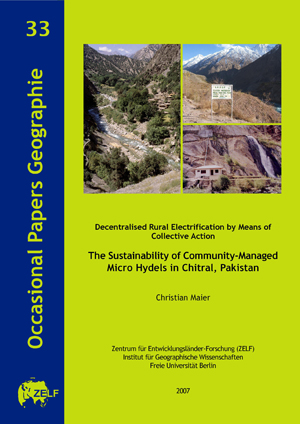
Decentralised Rural Electrification by Means of Collective Action: The Sustainability of Community-Managed Micro Hydels in Chitral, Pakistan
Programmes for rural electrification, as the most prominent approach to rural energy development, are commonly embedded into rural development policies of developing countries. As in most cases national power utilities are entrusted with the task of rural electrification, these programmes are most often designed as centralised grid extension programmes. These are, however, expensive and, due to scattered villages in rural areas, do not always represent the least-cost solution for electrification. Therefore decentralised electricity and generation through diesel generators or renewable energy (RE) can often be considered as more appropriate and cost-effective. (…)
The most common business model for developing renewable energy mini grid systems is community-based organisations. Regarding the electrified village, such a community managed project requires collective action – “voluntary action taken by a group to achieve common goals.” However, in contrast to a state-owned or private solution, electricity generated in that way has characteristics of common-pool resources (CPRs), whose utilisation would, according to Hardin’s (1968) thesis, in the long term result in a “tragedy” due to over-exploitation by the users.
An example of a decentralised rural electrification project with community-managed electricity generation is the micro hydel programme of the Aga Khan Rural Support Programme (AKRSP) in Chitral, the mountainous northernmost district of the North West Frontier Province (NWFP) in Pakistan. (…)
In order to answer the question, what factors influence or even imperil the sustainability of community-managed micro hydels and to what extent Hardin’s thesis applies to these projects, a three month research internship with AKRSP in Pakistan was carried out. One month was spent in its headquarters in Gilgit, in the Northern Areas, for the collection of secondary data, and two months in the Regional Office in Chitral. Thence 27 micro hydel projects were visited and interviews with persons involved in the management of the projects were conducted.
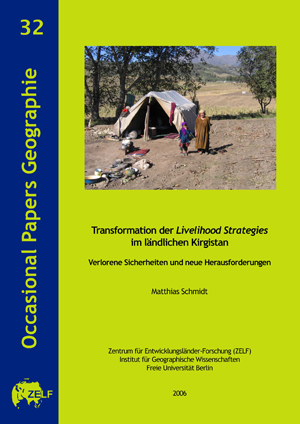
Transformation der Livelihood Strategies im ländlichen Kirgistan: Verlorene Sicherheiten und neue Herausforderungen
Im ehemaligen sowjetischen Mittelasien erklärten im Jahre 1991 fünf neue Staaten ihre Unabhängigkeit: Kasachstan, Usbekistan, Turkmenistan, Tadschikistan und Kirgistan. Die Unabhängigkeit dieser Länder war jedoch weniger das erklärte Ziel von vorausgegangenen Bestrebungen, wie etwa in den ostmitteleuropäischen Staaten, sondern eine Folge der Implosion der Sowjetunion. Unerwartet wurden die politischen Führer der mittelasiatischen Teilrepubliken vor die Aufgabe gestellt, einen eigenen neuen „Staat zu machen“ und, so die Wunschvorstellung des Westens, die als alternativloses Vorbild genannten Liberalisierungs- und Demokratisierungsstrategien umzusetzen. (...) Wie die vergangenen 15 Jahre seit der Unabhängigkeit gezeigt haben, verfolgen die Regierungen der neuen mittelasiatischen Republiken jedoch sehr unterschiedliche Entwicklungspfade, in denen marktwirtschaftliche oder gar demokratische Prinzipien nur bedingt umgesetzt werden.
Das Ziel der vorliegenden Abhandlung besteht darin, der Frage nachzugehen, wie sich diese oftmals akademisch formulierten und auf der Makroebene initiierten Transformationsprozesse auf die Lebensbedingungen der Mikroebene, genauer gesagt der privaten Haushalte im ländlichen Kirgistan auswirken. Dabei ist die postsozialistische Transformation als ein Prozess des gleichzeitigen Wandels des gesamten Gesellschaftssystems mit seinen ökonomischen, politischen und rechtlichen Subsystemen aufzufassen.
Aktuelle Forschungsbeiträge zu Südasien: 6. Jahrestagung des AK Südasien, 22./23. Januar 2016, Osnabrück
Extended Abstracts der 6. Jahrestagung des AK Südasien, 22./23. Januar 2016, Osnabrück.